kencierp wrote:
So here is my exchange with the Martin factory Engineer regarding why their finger boards are actually thicker on the extension than on the nut end (counter to the fall away concepts). The explaination makes perfect sense!!
Hi Mark,
Wondering if you have some technical insight regarding an observation I made regarding Martin Factory specs for fingerboard thickness. There seems to be a trend with some boutique makers to taper the extension end of the fingerboard (calling it fall off or fall away) making it slightly thinner -- there are all kinds of, frankly non convincing explanations as why this is a good thing.
So here's my question -- if my measurements are correct Martin does just the opposite the loose boards I get from the factory and the ones glued in place are actually thicker on the extension end than the nut end -- I'd like to know the reasoning behind that design strategy.
Any information that you or others can provide would be appreciated.
Thanks in advance,
Ken
Hi Ken,
We put a taper of roughly .010 from the nut end to the very end of the fingerboard. The reasoning is that the radius on the fingerboard thins out the edge of it as the overall width changes from (narrow at the nut end) to (wide at the very end). By increasing the thickness throughout the length, it helps keep: side dots centered to the bottom edge of the fingerboard, the end fingerboard from cupping due to fretting, proper bridge height/fingerboard drop.
I hope this answers your question.
Thanks,
Mark
There is nothing that I appreciate more in seeing is when we want to know something and someone goes to the source and actually asks! Good going Ken!
My read of the reply is a bit different though and I don't see it as counter to the fall-away concept. I most certainly could be wrong too, I am rather good at being wrong by the way...

Anyway what I am understanding from Martin's reply is hat they are addressing the question about the boards thickening and verifying same listing some reasons why.
But in the greater context of how Martin builds guitars they also flatten the upper bout removing any radius which also creates fall-away automatically. This is how I build my own stuff too and have a toot on my site called "Flattening The Upper Bout" that discusses why it's done to achieve fall-away with some added benefits such as not having to do any unnatural acts to get the fret board extension to lay nice and flat in that region.
By flattening the upper bout fall-away is engineered into Martin's designs although thickening the fret board can counter this to some degree too.
Martin does mention "fret board drop" which is also fall-away perhaps.
So my read of this communication is not that Martin does not do fall-away and again I most certainly could be wrong.
Regardless though why we (our shop) induce fall-away and many others do too has everything to do with how strings vibrate, players play, desired action, and removing one limiting factor that can prevent an instrument from being set-up with the desired action.
Fall-away also very much benefits electrics and in our repair world anyone who does much in the way of repairs will know about the Fender style, bolt-on necks and the "ski-ramp" that often happens (most of the time by the way...). This rising of the fret board over the body becomes one of the most profound limiting factors in these guitars to achieving buzz-free low action. So any fret dress of this style of instrument at least for our shop starts with milling away the ski-ramp. The same holds true for acoustics as well although we rarely see them ski-ramp what we do see is the absence of fall-way which in an of itself becomes a limiting factor to low action as well.
So fo us, meaning our shop and many pro Luthiers who I know personally who do this too fall-away gets you a couple of things. First it helps to eliminate the limitations from getting low action that not having fall-away can't do. Much of this is science having to do with the strings and how and where they vibrate and how the waves travel, react, etc. I'm going to ask Dave to come along and explain this part knowing as I do that he understands it better than I.
Additionally as we all know players have different styles, levels of attack, picks, no picks, Robin Hood arrested development, etc. So the players and how they play is part of this answer too in that an instrument with no fall-away may be perfectly fine for some players and absolutely unworkable for others.
I watched a client with a new Breedlove last evening use his thumb to pull the low e out about 3/4" and then let it slam into the frets..... This guy needs fall-away.....
I'll ask Dave to weigh-in here when he can and shed more light on how the strings vibrate and fall-away. We have a "mono-cord" set-up on a surface plate that he uses for these kinds of experiments.
By the way for builders we can't always know who will end up with an instrument that you or I built. Having fall-away will permit different set-up possibilities that not having fall-away will not permit. That's why I do it when I build my stuff as cheap insurance against that one player who thinks that they are Robin Hood....























 Login
Login Register
 FAQ
FAQ



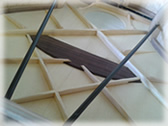


 . Nor are we addressing and attempting counter future upper bout distortion, body joint humps, etc.
 The first one to correct guess is the weiner and wins a tub of OLF lard....
![[uncle]](./images/smilies/surrenderflagqv6.gif "Uncle")